
Every wave of legal technology has reached public defense last. Prosecutors got integrated digital evidence systems while defenders got file cabinets and burned DVDs. Private firms got e-discovery platforms while public defender offices got Access databases held together by one heroic IT person. Now frontier AI is arriving, and the pattern threatens to repeat, but for a different reason. This time the barrier isn’t only budget. It’s trust. Chief defenders are asking the right question: what happens to privileged client data when it touches a large language model?
This month, we upgraded ZLS.ai, the AI layer inside ZLS.app, to OpenAI’s newly released GPT-5.6 models. The upgrade itself took our users no effort at all, and that’s the point. But before we talk about what changed, it’s worth talking about why we built it the way we did. The philosophy matters more than the version number.
The Real Barrier Isn’t Capability. It’s Privilege.
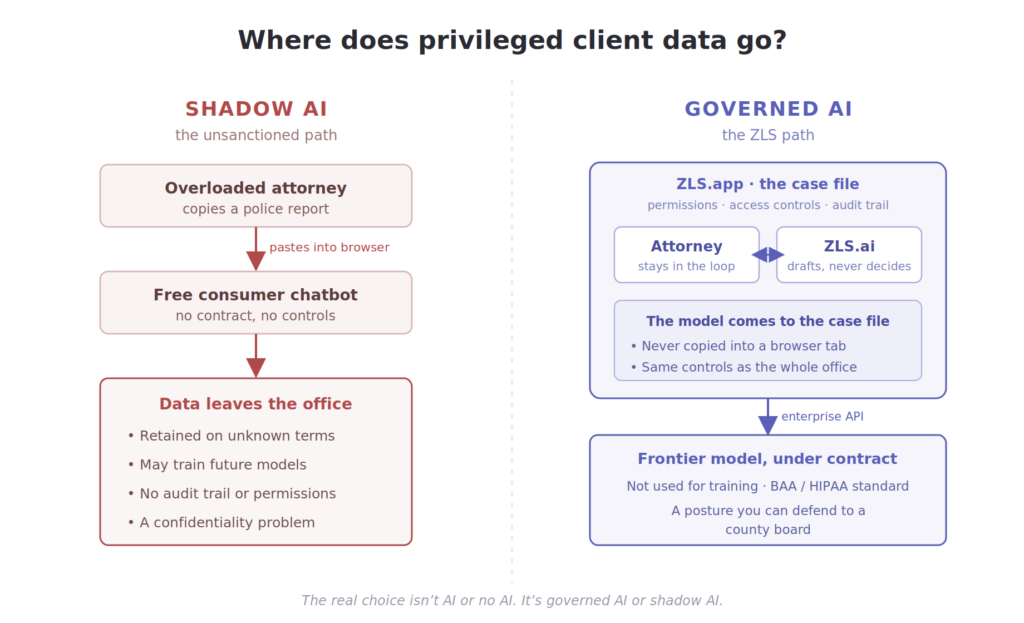
The caution in our field is warranted. Consumer AI chatbots, the free tools where most people first met this technology, can use conversations to train future models, retain data on terms the user never negotiated, and offer no contractual protection at all. An attorney pasting a police report into a free chatbot isn’t modernizing; they’re creating a confidentiality problem. The ABA’s Formal Opinion 512 made this explicit: the duties of competence, confidentiality, and supervision extend fully to generative AI.
But the wrong conclusion is abstinence, because the digital tsunami isn’t waiting for anyone’s comfort level. A single felony case can now arrive with hours of body-worn camera footage, hundreds of pages of discovery, and a client whose history spans years of prior representations. And here’s the uncomfortable truth every chief already suspects: if an office doesn’t provide a safe, sanctioned way to use AI, overloaded attorneys will find unsanctioned ones. The real choice isn’t AI or no AI. It’s governed AI or shadow AI.
Our Philosophy: Frontier Capability, Defender Control
We built ZLS.ai around a few non-negotiable principles.
Privileged data deserves contractual protection, not a settings toggle. ZLS.ai connects to frontier models through enterprise API agreements, including a signed Business Associate Agreement. By contract, client data is never used to train the models, and the health records that run through so many defense cases, from competency evaluations to treatment histories, processed under controls designed to support HIPAA-compliant use and covered by our BAA. That is a fundamentally different legal posture than a consumer chatbot’s privacy settings, and it’s the difference between a tool a chief can defend to a county board and one they can’t.
The model comes to the case file, not the other way around. Attorneys shouldn’t be copying privileged material into a browser tab. In ZLS.app, AI works inside the case management system, subject to the same permissions, access controls, and audit trail as everything else in the office. Integration over silos isn’t just a workflow preference; it’s a confidentiality architecture.
The attorney stays in the loop. AI in ZLS drafts, searches, compares, and synthesizes. It does not decide. Every output is a starting point for defender judgment, built so the lawyer can verify against the underlying source material. The goal is converting administrative drag back into advocacy time, not automating advocacy itself.
It has to be built for public defense. General-purpose tools don’t know what a suppression issue looks like, why a prior attorney’s notes on a returning client matter, or how a defender reads a probable cause statement. Domain context is what separates an AI feature from an instrument of defense. It’s the same reason ZLS exists at all: built by public defenders, for public defenders.
What the GPT-5.6 Upgrade Changes in Practice
Because ZLS.ai is built on this API architecture, upgrading to GPT-5.6, OpenAI’s newest and most capable model family released this month, required no re-platforming, no IT project, and no retraining for staff. The guardrails stayed exactly where they were. The engine underneath got sharper.
In practice, that means the workflows offices already rely on get better: searching across sprawling discovery, comparing body camera footage against written police reports and flagging where they diverge, synthesizing years of prior attorney notes when a client returns, and surfacing the people who matter across a complex case file. The newest models are meaningfully stronger on exactly the long, messy, document-heavy work that defines modern indigent defense.
The frontier will keep moving. When it does, our offices move with it, days later rather than years later. That’s what it looks like when public defense stops being last in line.
Where This Goes From Here
Holistic, client-centered defense has always depended on defenders knowing more about their clients and their cases than the system expects them to. Frontier AI, deployed with the right safeguards, is becoming part of how offices meet that standard at modern caseload volumes. If your office is thinking through how to adopt AI responsibly, with ZLS or on your own path, we’re always glad to compare notes. It’s a conversation our whole field needs to get right.
