
If you have ever tried to reconstruct a crucial exchange from a jail call or a chaotic body‑worn camera clip, you know the problem. Multiple voices, overlapping audio, poor quality, and a generic transcript that reads “SPEAKER_00,” “SPEAKER_01,” and “SPEAKER_02” down the page. It is technically a transcript, but it is not yet advocacy‑ready. Public defenders are already spending 10–15 hours per case cleaning up and transcribing poor‑quality audio and video evidence, often just to figure out who actually said what and when.
This is not just irritating; it is a clear example of administrative drag pulling time away from advocacy. Jail calls, body‑worn camera footage, and interview recordings all carry key facts, but when they live in different systems and are not tied back to the people in your case file, defenders are forced to manually stitch the story together.
From “SPEAKER_00” to Real People in Your Case
Most AI transcription systems can tell there are different voices on a recording. The real leap for public defense is when those voices can be tied to real people you are already tracking in the case: officers, your client, family members, witnesses. Clear speaker identification is critical for evidential accuracy and avoiding misattribution of statements in high‑stakes legal matters.
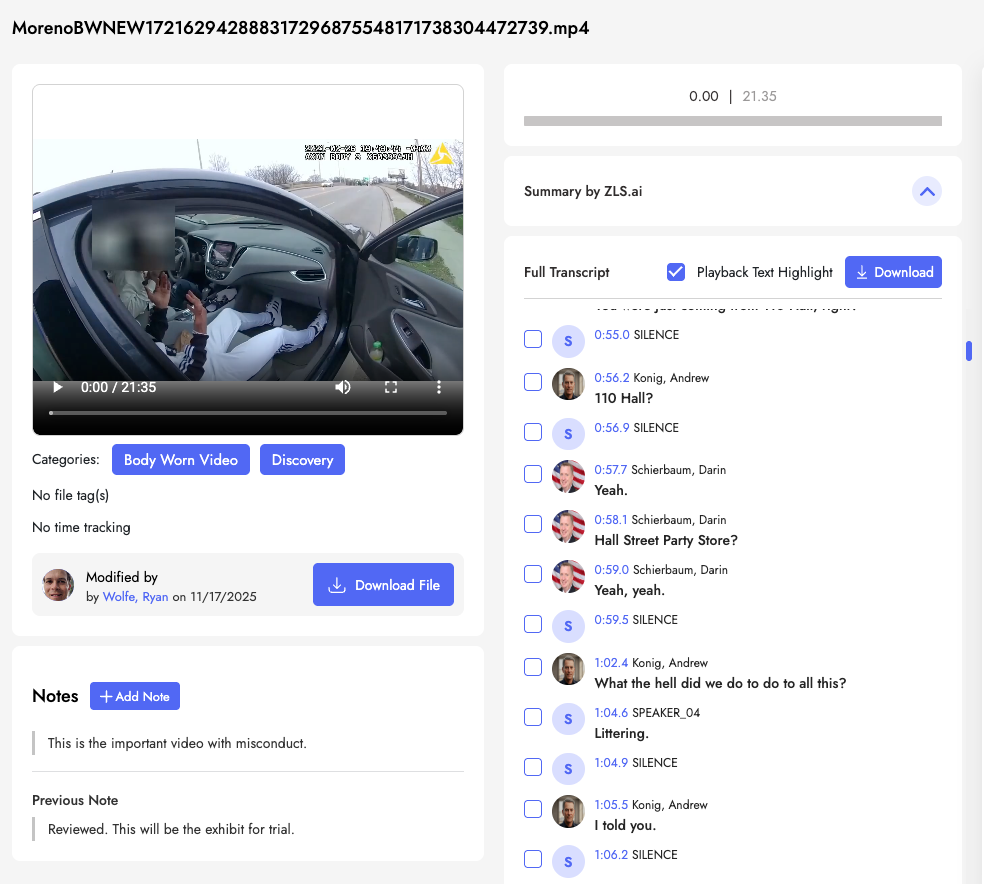
In ZLS.app, smart speaker labels start with AI detecting distinct voices on a jail call or body cam video. You then assign each “SPEAKER_00”–style label to an actual person from your Case People list. Once you link “SPEAKER_01” to “Officer Konig” or “Client,” every line that voice speaks updates across the transcript in one step. Suddenly the text reads less like a machine dump and more like a deposition:
Officer Konig: “I told him it was a consent search.”
Client: “No, I did not say you could look in the trunk.”
On a jail call, it might look like:
Client: “I already told the officer I did not want to talk without a lawyer.”
Family Member: “They are saying you agreed to everything.”
This is AI‑assisted review, not AI in charge. The system helps separate and label the voices; the defender decides what those words mean for suppression, impeachment, or negotiation.
Jail Calls and Body‑Worn Video in the Same System
For most offices, the real pain comes from volume and fragmentation. Hours of jail calls stored in one place, body‑worn camera footage in another, case notes and officer lists in a third. As audiovisual evidence mounts, public defenders are struggling to keep up and to use that material effectively in client‑centered advocacy.
A unified system built by public defenders for public defenders treats those recordings as part of the same record. When you tag a voice on a body‑worn camera clip as a particular officer, that same officer already exists in your case management system, along with their prior cases, Brady notes, and subpoenas. When you tag a caller on a jail recording as your client or a family member, that relationship is already reflected in your case people list.
Over time, this lets your office:
-
Jump directly to every clip where a specific officer appears across cases.
-
Track how an officer’s account in body‑worn video lines up with what is said on jail calls or in reports.
-
Quickly find all jail calls where a client discussed a disputed event or condition of release.
Instead of audio and video living as isolated files, each labeled voice becomes part of a richer Public Defender Experience (PDX) inside the same system you use for tasks, hearings, and outcomes.
Data as a Byproduct, Not Another Burden
Most chiefs want better data on workload and outcomes but are understandably wary of adding more boxes for attorneys to check. The question is how to unleash the data already inside ordinary defense work without turning lawyers into data clerks.
Smart speaker labels connected to your case management system are a concrete example of data as a byproduct, not a burden. When an attorney or investigator links a voice on a jail call or body‑worn video to a known officer or client, they are doing what they already must do to understand the evidence. In the background, the system is quietly capturing:
-
How many hours of jail calls and body‑worn video a case involved.
-
Which officers appear most often across your docket.
-
How often there are inconsistencies between what an officer says on scene and what appears in other parts of the record.
Commentators on digital evidence in public defense are already noting that AI‑supported transcription and integrated evidence management can help offices reclaim time and cope with the digital tsunami of audiovisual material. The advantage of a defender‑built, unified platform is that these gains are aligned with holistic defense and client‑centered practice, not just generic efficiency metrics.
Greater Than the Sum of Its Parts
AI transcription, smart speaker labels, jail call platforms, body‑worn video portals, and case management tools all exist on their own. But for public defender offices, the real value shows up when they work together instead of in silos. When every statement on a jail call or body‑worn camera clip is tied to a real person in your case file, and every recording lives alongside your notes, tasks, and litigation strategy, your office is not just “going digital.” It is building a living, searchable history of your advocacy.
That is the vision behind integrating smart speaker labels with AI into ZLS.app: reduce administrative drag, protect advocacy time, and quietly build the data you need to show the true scope and impact of your work. If your office is wrestling with how to manage growing volumes of jail calls and body‑worn video, this is one practical way to make that evidence work for your team instead of against your time.
