
Artificial Intelligence (AI) is no longer a futuristic concept—it’s a present-day reality rapidly transforming the legal landscape. For Public Defender (PD) offices managing complex, high-volume caseloads, integrating AI is becoming essential for maintaining efficiency and delivering zealous advocacy.
Based on recent discussions with PD leaders across the country, here are four key takeaways your office must consider when developing a successful AI strategy:
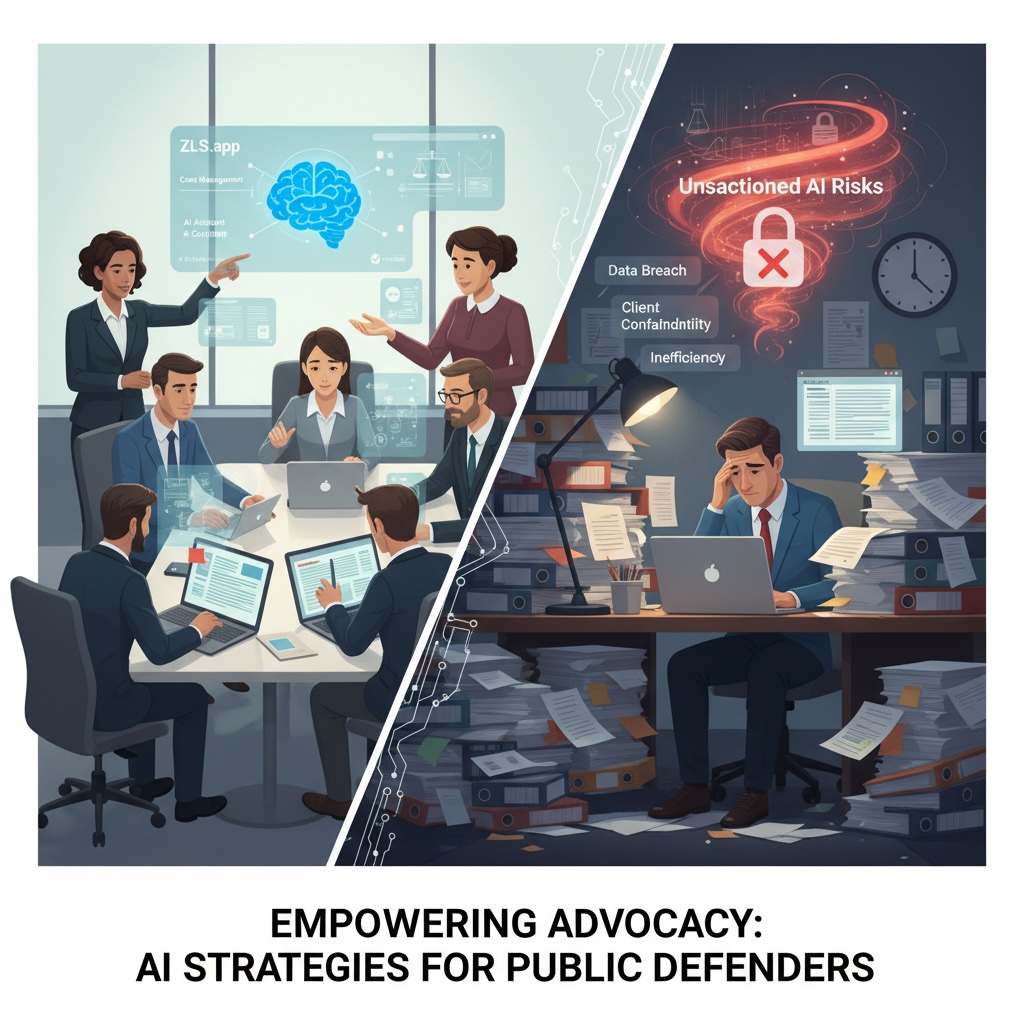
1. Your Staff is Using AI, With or Without Your Blessing: Prioritize Safe, Compliant Tools.
The reality is that generative AI tools are widely accessible, and your attorneys are already turning to them for quick answers, drafting support, or document summarization. However, using unsanctioned, public-facing tools can expose confidential client information and sensitive work product, violating ethical and security protocols.
- The Solution: PD offices must provide secure, compliant, and powerful AI tools directly integrated into their case management system, like ZLS.ai. This ensures that all generative AI features operate within an architecture designed for the attorney-client relationship, featuring field-level encryption for sensitive data. When staff have a safe, in-house option, they can leverage AI’s benefits without risking data breaches.
2. AI is Much More Than Just ChatGPT: Adopt a Holistic, Multi-Faceted Approach.
Limiting your AI understanding to just Large Language Models (LLMs) like those powering ChatGPT misses the broader, more transformative potential of modern AI. Effective legal AI requires a combination of technologies to tackle the “digital tsunami” of evidence.
- The Solution: A holistic approach integrates:
- LLMs (Generative Pretrained Transformers): For quick document summarization, answering case-specific inquiries, and drafting tasks.
- Transcription (e.g., Whisper AI): For precise audio and video transcription, turning body-worn camera footage, 911 calls, and other recordings into searchable text and identifying key segments.
- Optical Character Recognition with Computer Vision (OCR): To make even the most challenging scanned documents fully searchable and available for further AI analysis.
- RAG and Embeddings: Passing through large datasets is not enough. You need a smart way to parse and process large datasets.
3. Building or Buying Standalone AI Tools is Not Enough: Integration is Critical for Full Value.
The AI industry moves quickly. If you build your own solution, you risk it becoming instantly outdated. If you buy a standalone tool, you risk creating silos, forcing attorneys to manually copy and paste privileged information between systems—defeating both the efficiency and security goals.
- The Solution: Your AI functionality must be embedded directly within a comprehensive case management system that acts as the “file of record”. ZLS.app integrates its AI, file storage, email, and communication tools onto a single platform. This seamless integration ensures:
- AI has secure access to all relevant case files, notes, and documents for a complete contextual analysis.
- Attorneys can get real-time insights without leaving the environment, linking AI summaries, conflict alerts, and key insights to the case log instantaneously.
- Future updates and new AI capabilities are rolled out seamlessly at no additional cost.
4. Strategic Deployment of AI is a Key Staff Retention Strategy: Give Time Back to Advocacy.
Public defenders consistently face heavy caseloads and administrative burdens, leading to burnout and high turnover. Technology that truly saves hours of manual work is a direct investment in staff morale and retention.
- The Solution: Deploying an integrated platform that eliminates administrative friction fundamentally changes the daily life of a PD. ZLS.app’s approach to Public Defender Experience (PDX) focuses on efficiency:
- Automation: Automated court appearance text reminders reduce Failure to Appear (FTA) rates and administrative follow-up.
- Simplicity: Intuitive case logging, mobile accessibility, and no-code custom fields minimize time spent on data entry and maximize time for client interaction.
- Insight: Proactive conflict checking and data visualization tools surface critical information fast, enabling strategic decision-making and allowing defenders to focus on their clients.
By addressing these four pillars, your PD office can leverage AI not just as a technology upgrade, but as a strategic tool to empower advocacy, ensure security, and retain your most valuable asset: your dedicated staff.
