
Every public defender knows the difference between finding a document and knowing a case. Search can tell you a police report exists. It cannot tell you that the officer’s account on page four doesn’t match what he says twelve minutes into his body-worn camera footage, or that the plea offer a colleague mentioned three weeks ago is buried in a jail visit note. That second kind of knowledge is what defense work runs on, and it is exactly what the digital tsunami of discovery makes hardest to hold in your head.
When we released the ZLS.ai 2.0 beta, defenders across the country put it to work and told us directly what it needed to do better. The message was consistent: they didn’t want AI that finds things. They wanted AI that reads the file. ZLS.ai 3.0 is our answer, rebuilt from the ground up around defense-specific logic and shaped by what defenders told us they needed.
What Should an AI Assistant Understand About Defense Work?
General-purpose AI knows law the way a bright first-year student does. It doesn’t know defense practice, and it doesn’t know your office. A defense-aware assistant has to understand what a charge means for a client’s exposure, where jail visits and plea offers tend to live in attorney notes, which document answers which question, and that “bodycam” and “BWC” mean the same thing.
It also has to meet defenders where they are. Nobody between a morning calendar call and an afternoon jail visit has time to engineer the perfect prompt. ZLS.ai 3.0 takes questions the way a colleague would, misspelled names and office shorthand included. When something is truly ambiguous, like two clients who share a name, it asks rather than guesses. In a practice where pulling the wrong client’s file is a confidentiality problem, that restraint matters more than speed.
And it isn’t only for attorneys. Holistic defense runs on a team, and each role asks different questions of the same file. An investigator asks who the people on a case are and where a witness is mentioned in discovery. A social worker pulls up mental health evaluations and letters from family. A supervisor asks how many active cases each attorney carries or which cases office-wide are closest to trial, and gets real counts from the office’s own records, every line checkable.
How Can Defenders Verify What AI Tells Them?
They shouldn’t have to take it on faith, and the duty of competence says they can’t. Every AI output a defender relies on needs human review. The practical question is how long that review takes, and whether it fits into a day that is already overbooked.
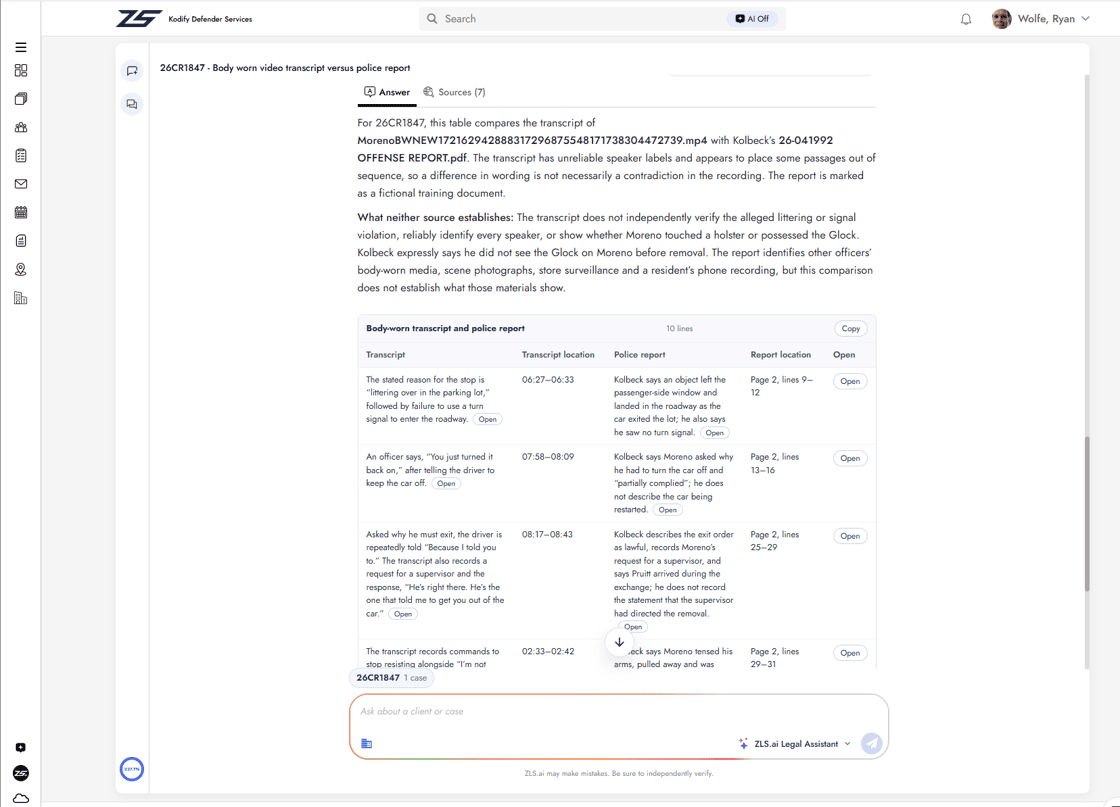
ZLS.ai 3.0 shows its work. Each answer states what it understood the question to be, what it assumed, where it looked, and what it didn’t cover. Every fact links back to its source: the page of a report, the specific note, the timestamp in a recording. Verification becomes a click, not a second read of the whole file.
Consider cross-examination prep. A defender asks for an impeachment chart comparing Officer Reyes’s police report to his body-worn camera transcript. What comes back is each statement side by side, with page and timestamp, and the discrepancies spelled out. The attorney still decides what matters and how to use it in front of a jury. But the hours that used to go into building the chart by hand go back to advocacy.
That trust extends to how client information is handled. ZLS.ai 3.0 runs on OpenAI’s newest model generation, GPT-6 Sol, under the same enterprise contract terms and Business Associate Agreement that protect privileged information in ZLS.ai today. Just as important, the assistant sees only what the signed-in user can see. It follows the access rules your office already has in place, so a case a user can’t open is a case the assistant can’t read for them, and your administrator decides which actions each user is allowed to take.
What Does AI Work Product Look Like Inside the Case File?
Answers are only half the job. Defenders need things they can use: an impeachment chart for cross, a caseload breakdown for a supervisor, a list of overdue tasks before a staff meeting. ZLS.ai 3.0 produces clean, copyable tables and drafts full motions and client letters from the record and the office’s own approved templates, so the work product reflects how your office actually practices.
Take the moment a plea offer arrives. An attorney asks what the client’s exposure looks like if he takes the offer versus going to trial, then asks for a letter explaining the offer to the client. Both the analysis and the draft start from the case file, not a blank page. The assistant lays out the options. The client still makes the decision. The client’s understanding of his own case stays at the center, which is where holistic defense begins.
The assistant can also act, with permission. Walking out of the jail, a defender can ask it to log a note that she met the client and discussed the offer. She previews the entry, approves it, and it’s recorded. Setting hearings and assigning tasks work the same way, and any action can be undone. That is data as a byproduct of the work rather than another form to fill out at 7 p.m., and it is the same record that later lets an office show its county board what its attorneys are actually carrying.
Why Can ZLS.ai Read the Whole File?
An assistant is only as good as the record it reads, and in most offices the record is the hard part. Discovery arrives as hours of footage and stacks of scanned PDFs. That’s why ZLS.ai 3.0 isn’t a chatbot sitting on top of a case management system. It’s the front door to AI that is already working throughout ZLS.app.
Transcriptions turn body-worn camera and interview recordings into searchable text, and AI Vision reads scanned documents that would otherwise sit outside any search. Witness Extraction pulls the people named in discovery into the case, and Witness References shows where each one appears across the file. AI-Aided File View helps defenders work through long documents without losing the thread, and Office Knowledge brings the office’s approved policies, motion templates, and practice guides into any answer that needs them. ZLS.ai Redaction takes on one of the most tedious jobs in discovery, preparing redacted copies before documents go to a client, without marking every line by hand. And Agentic Actions is the foundation behind the assistant’s ability to log notes, set hearings, and assign tasks with your approval.
That is integration over silos in practice. When the assistant builds the impeachment chart on Officer Reyes, it is drawing on a transcript, a scanned report, and a witness list that ZLS has already processed, all sitting on the case file where they belong.
Built by Defenders, Shaped by Defenders
ZLS.app was built by public defenders for public defenders, and 3.0 is the clearest example yet of what that means in practice. The direction for this release didn’t come from a product roadmap. It came from defenders who used the beta and told us what was working and what wasn’t.
The real test of any AI tool in a defender office isn’t whether it can answer an easy question. It’s whether it can handle the one that requires reading the whole file. If your office is weighing how AI fits into its practice, that is the question worth bringing to every tool you evaluate, including ours. And if you already use ZLS, bring it to 3.0 and tell us how it did. That kind of direct feedback built this version, and it will shape the next one.
